If there's anything I really hesitate in doing, it's calling myself "a writer." The reason used to be some sort of self-effacing fear of narcissism, but now it's boiled down to the simple fact that I don't write very often and therefore I do not feel the right to call myself a writer. Sure, I have more than a passing interest in writing and story and I even find myself thinking about these subjects quite often, without specifically trying. That's what I call "one's passion." It is the thing you think about when you're not really trying to think about anything. I know the passion is there and even the capacity to write is there, but for some reason I have a real problem with actually getting down and writing something.
I could say part of the problem is the Internet. Whenever I write, I do it on my computer, so I get constantly distracted. But I almost feel that if it wasn't the Internet distracting me, it would be something else.
I can't remember his name, but a respected screenwriter wrote about the concept of a person not doing work because of some abstract, inner force. He wrote about this in a very concrete way, and he had a word for it, but the point of it was that whenever someone, anyone, aspires to something good, like writing, or running a race, or inventing a device, there is a force that quietly tells you to take a break, stop working, just do nothing. It's as if there's a part of the brain that specifically advises you to be lazy.
I subscribe to this idea because I feel like I am a victim of it. I know I can write a screenplay. I know I can do everything involved - create characters, plot, conflict, blah blah blah, etcetera. But I just don't, when it comes time to write, I just lose complete interest.
But this isn't to say I've given up. What this almost tells me is that I need to find out how I work. In Bill Mai's class, Working with a Partner, I've found that I've maintained interest in the project because of my partner. My partner hasn't even had to coach me or anything - just because he is there, I'm automatically more interested. The process seems much less torturous.
Also in that class, I've been working to create a beat sheet for my proposed project. I feel like a beat sheet, or some kind of system to plan the story ahead of time, may be a great and helpful method.
Sunday, January 30, 2011

Wednesday, January 19, 2011
Eternal Sunshine (2004, Charlie Kaufman)
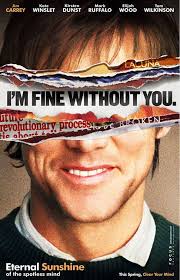
After reading the draft of Eternal Sunshine of the Spotless Mind for class, a tremendously sad thought came to mind: was the success of the movie an accident?
By "success" I refer to my own thoughts about the film. Eternal Sunshine may be my favorite movie and I am not one to make lists or cite favorites. But there have been few movies to stimulate my thoughts about life as this one has done before and continues to do upon further viewings. This is a movie that was a fantastic, absorbing story and it makes me think about ideas and concepts it investigates, like consciousness and memory.
Every element of the movie is perfect - acting, shot choice, editing, music, lighting, writing, special effects. Nothing pulls me out - every aspect of the movie makes me forget I'm watching a movie.
But then I look at the script. Granted - and this is a humongous granted - this is not the shooting draft and the amount of unusual typos tells me that this may even be the first draft. But it makes me wonder: how much did Charlie Kaufman figure out in the script, how much did director Michel Gondry figure out on set and in the editing room, and how much just came out by complete accident and/or improvisation?
In other words, can something as incredibly beautiful as Eternal Sunshine be penned, as completely as possible, on the page? Sure, the director will find little bits, small emotional beats or line changes, that the writer never thought of and perhaps he or she will discover that in creating a certain rhythm in the editing a part of the story comes more easily to life.
But I look at the ES script and I see that many parts of the dialogue were excised, modified, or moved around. Many scenes were altered and moved around. And some entire sections - like the future-Clementine sequences - were entirely cut from the final movie. Large parts of the beauty of the film are in the script, but significant portions of the film diverge from the script.
So, when one looks at masterpieces of cinema, how many ever existed on the page as we view them?
Subscribe to:
Posts (Atom)