Monday, March 7, 2011

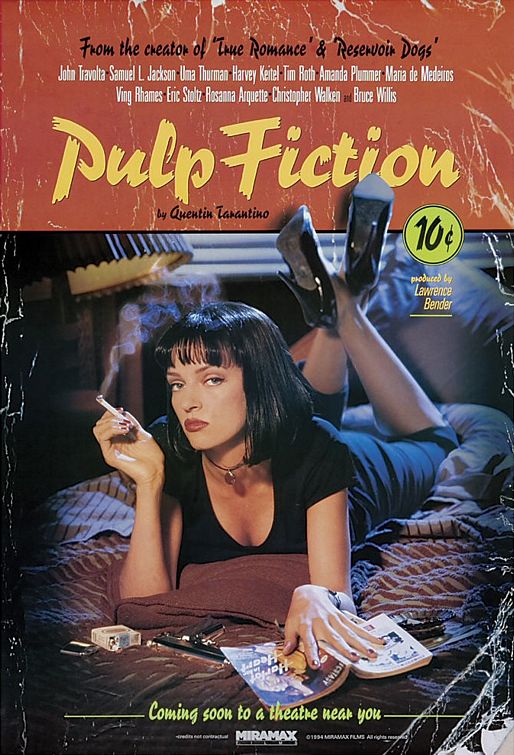
Pulp Fiction (1994, Quentin Tarantino and Roger Avary)


What can be said about this script but "Wow!" It comes to life right off the page. It would honestly be enough just to read this script - that's more than I need. But to see it in action is wonderful as well.

Anyways, if there's one thing that always hits me about Tarantino and his situation is that everyone tries to copy two things from him: non-linear storylines and pop-culture referencing dialogue. While the first one you can copy to the end of time because it's not his invention, the other aspect is really the unique spark that makes him him. In other words, its impossible to copy.

But more importantly, it need not be copied. Why? Because that stuff is what makes it Tarantino, but that's not what makes it good.

What makes a Tarantino script good - outside of the wildly inventive dialogue - is the scenarios themselves. And I don't mean specifically two people holding up a coffee shop or some guy accidentally blowing another guy's head off. All of that is incidental. What makes his stuff great is that he focuses more on the characters than the scenario or scene and lets the scene or scenario flow directly out of the characterization.

In fact, on a recent interview with Charlie Rose, Tarantino talks about how the characters just talk, he makes them up and they lead him. He's said this before, of course, but he added one little tidbit which was that sometimes he might want a character to, for instance, walk from Point A to Point B. But in writing the scene and letting the character control itself, the character may decide it doesn't want to go to Point B, it may want to go to Point C.

In other words - in the same way he lets the characters' dialogue flow naturally without trying to preconceive or construct it, so do the scenarios come into creation, naturally and organically from the nature of the characters.

Thus, when Jules and Vincent walk into the apartment to get the briefcase, they approach the situation in a way ONLY THEY WOULD HAVE DONE IT. They don't barge in, guns blazing, because Tarantino thought that would be cool. What he's doing is he's approaching the material as an observer and letting the characters do things the way they want to do it.

And the end result of this way of writing is the set-piece, or a long, sustained sequence following one or more characters through one central action. For instance, the Vincent and Mia date sequence. This makes things slightly episodic, but as Pulp Fiction shows, this can work great. And of course, by making it non-linear, Tarantino not only makes the episodic nature work, he makes it work to his advantage.

Network (1976, Paddy Chayefsky)


"Network" seems to be one of those scripts that is held in hugely high esteem by screenwriters. It's like "All the President's Men" or "Alien" or its just one of the screenplays you point out to people who want to learn everything there is to know about writing for the screen.

Network is interesting mostly because the writer - Paddy Chayefsky - is less interesting in how the screenplay is written. Which is to say, it does not stand out the way Alien or President's Men. There are certain interesting stylistic choices, like how he specifically states what the camera is doing or he'll point out a really specific time that an action occurs. But what stands out in the script is the characterization and the story.

As a brief sidenote, I'd be interested to know the history of screenwriting format. What was acceptable in the 70's that isn't now? How, actually, did screenwriting even begin? I've never really considered it - who wrote the first screenplays, who chose the formatting?

Anyways, back to Network - what makes it amazing is how it chooses a tone and sticks to it. The movie itself is outright, blatant satire, but what Chayefsky does is cleverly mix it with absolute reality and some sense of sanity. This way, when insanity comes stomping into the room, it is apparent and abundantly clear that what we are seeing is the very definition of insane, i.e. the big boss at UBS talking to Howard.

Each character in the story really stands out. I feel like this is easily one of the hallmarks of a great writer - not too many characters, just the right amount, and the writer arrived at these characters by bringing life and depth to each one and he essentially executed the empty, poorly drawn characters.

There's Howard himself, the vessel for Chayefsky's voice and opinions concerning the takeover of television into America's life. Then his boss Max Schumaker that is trying to fight for Howard and save his life. Then there is the big man at UBS, Frank Hackett, who has such a great name being the hatchet man at the company. And of course the stand out character is Diana Christenson, an essentially evil, maniacal personality.

I love when a character is set up so clearly and then played out according to that setup. With Diana, for instance, it's set up that for some pathological reason, all she cares about is making a good show and getting the best ratings. And every action she takes is towards completing that objective. It's clear and concise. Chayefsky knows what he wants her to do and doesn't waste time having her go back and forth, questioning any of this. He sets a clear path and it's watching her go down that path that provides the story and the entertainment.

Saturday, March 5, 2011

Hannah and Her Sisters (1986, Woody Allen)


Reading the script for Hannah and Her Sisters, I can see that Woody Allen has more of a plan when's he's making his movies (or at least this one) than I expected. I heard stories of him not asking for another take on Bullets Over Broadway because a Knicks game was starting soon and he wanted to go watch it. There's something about Woody Allen where it seems like he's born to make movies but maybe he doesn't really like them.

Anyway, in the script, there's all kinds of detailed detritus that tell you what he's thinking. For instance, characters will sometimes have dialogue that is indicated as off-screen, implying where the camera is pointing and where the character is in relation to the frame. It doesn't help the story or add to the scene, it just shows you how he's going to block the scene. A strange addition, but I suppose that's not unusual for a director writing his own script.

The structure of the whole movie is very interesting. It covers somewhere around a year of time and it follows what seems like many handfuls of characters. But the main characters may be Michael Caine and Woody Allen. Surrounding them are Hannah, played by Mia Farrow, and her sisters played by Diane Wiest and Barbara Hershey. Then there's Hershey's boyfriend, played by Max Von Sydow. And there's Hannah's parents, which appear two or three times, and Woody's, which appearance at least once. But now I'm just listing secondary characters.

The point is that this story is more like a tableau; an episodic film that just feels like it follows people. Big changes do happen - Michael Caine and Barbara Hershey begin and then later break off an affair, and Woody Allen falls in love with Diane Wiest - but it really just feels like another year. Which I don't count as a bad thing. Sometimes I very much enjoy a film that doesn't focus on a plot, one that's barreling ahead toward some very specific conclusion.

Films like Hannah and Her Sisters simply feel more like life. It feels like something familiar, like something I experience every day. I love movies like Seven, for instance, where you're following two characters trying to accomplish one specific objective. But movies like Hannah and Her Sisters, or Manhattan, or Annie Hall just remind you about life and make you think about very simple things, like thinking about meaning and purpose in life, about love, about a career, about whatever it is that's important in your world. While a movie like Seven may be important in terms of story, in terms of the world having one more story on its shelf for all to read, a movie like Hannah and Her Sisters offers more for a person as an individual in terms of what they can learn about themselves and for that reason I find movies like these of great importance.

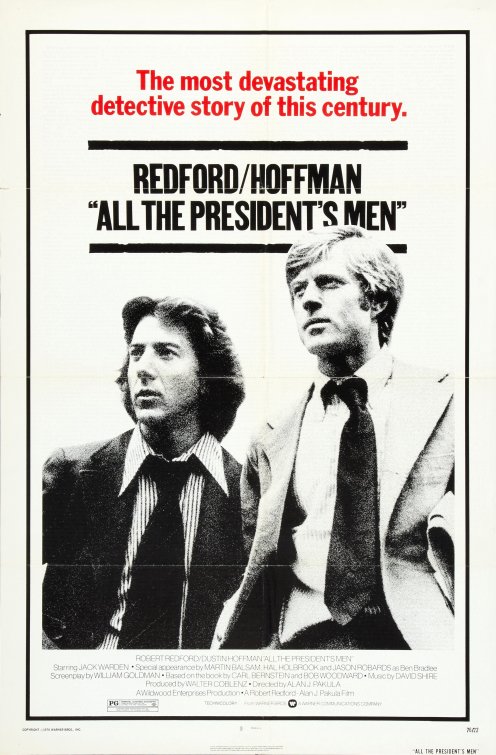
All the President's Men (1976 William Goldman)


There are some screenplays where I really love the style of how it's written, even though it goes against certain conventions of formatting. Alien. Pulp Fiction. The Social Network. They all work because they have their reasons and remains consistent. These reasons might not be hugely concrete - Pulp Fiction, for instance, includes a lot of unnecessary details in its descriptions, but it gives a great rhythm to the story and adds tons of character to the various settings. The feeling of that Alien haiku-style just makes everything immediate, dramatic, and a bit scary. The Social Network often eschews description in favor of simple lines of dialogue. We'll move between scenes without any physical action being described. But Sorkin uses dialogue as action and any minute movements are completely unimportant. By getting rid of the description, he allows the reader to race through the script at a lightning speed.

In the case of President's Men, however, sometimes I don't quite get it. Like the break-in - Goldman just says basically to play the scene out however you will, make sure to include this detail or that. It really makes me wonder what were the exact circumstances behind his writing this screenplay. Did he work directly with Pakula or was he just hired by the studio to write the screenplay, separate from any expectations of production? But it must have been clear that this was going to get made - this wouldn't have been a script that could ever have been tossed into a pile and forgotten.

Goldman no doubt went into the writing of this thing knowing that he had to write fast and that this was definitely going to get made.

And of course, when production ramped up, they would start doing their own research. No matter what Goldman put in the script, Pakula's researchers would have found out the exact sequence of the Watergate break-in and known it by heart. And that's probably why he just basically says "Do it, you know what you need to do."

I would say that the way he breaks scenes apart, without scene headings, is probably a mix of the speed at which he was working and the freedom he knew he could employ. He was probably playing around and had his own theories about writing. And now that the deadline was approaching, he put his own ideas about screenplays into effect. Who cares about scene headings? Why does all description need to be perfect and lead you by the hand, beat by beat?

Due to its style, it does have an interesting rhythm and speed to it. Personally, I don't like that the reason behind the style may not be quite as concrete as the other stories. But style is ultimately meaningless. I love the attention to detail, the focus on tracking things down, how every piece of evidence, every name and phone number was important.

It's a brilliant story because it's all about the case and all about the details.

The Apartment (1960, Billy Wilder and I.A.L. Diamond)


If there's one thing I love about Billy Wilder, it's how he's so damn good at setting things up and paying them off. Sometimes it's small details like Baxter's cold. It comes out of his situation with the apartment - waiting outside for someone to leave. But then the cold escalates and initiates props like the nasal spray and kleenex tissues. It climaxes in the first Sheldrake scene where Bud gets the promotion for lending his key to the big boss.

He also sets up and pays off bigger things in terms of theme that doesn't necessarily materialize physically. For instance, in the theme of the mensch, established by Bud's next door neighbor. It's ultimately what Bud should aspire to be and yet it is what he can't be as long as he's lending out his apartment to his superiors.

Wilder and I.A.L. Diamond are masters of the story beat as well. There's never an empty moment or a meaningless moment. They're always pushing the story forward.

Interestingly, The Apartment seems to be a mix of both pathos and comedy. I have a feeling it was Diamond who brought more of the comedy and Wilder who thought of the pathos. He was inspired by David Lean's "Brief Encounter," in which a man and woman have an affair at someone's apartment. Wilder was intrigued by the person who lent out the apartment and this formed the seed of the final film. Considering Diamond was the writing partner, he no doubt brought levity to the whole thing. I almost wonder if perhaps Wilder was more serious than one might expect (especially after seeing "Some Like It Hot") and it was his co-writers who either steered him closer to comedy (like Diamond) or toward drama (like Charles Brackett, with whom he wrote "Double Indemnity" and "Sunset Boulevard").

This was another of Wilder's scripts that wasn't complete before filming began. They would literally be writing as they went. I suppose seeing what they had helped show what they needed. I don't understand how this is even possible, but Wilder managed it for the majority of his movies. For this script, both of them won Oscars, so I guess it works.