There are some screenplays where I really love the style of how it's written, even though it goes against certain conventions of formatting. Alien. Pulp Fiction. The Social Network. They all work because they have their reasons and remains consistent. These reasons might not be hugely concrete - Pulp Fiction, for instance, includes a lot of unnecessary details in its descriptions, but it gives a great rhythm to the story and adds tons of character to the various settings. The feeling of that Alien haiku-style just makes everything immediate, dramatic, and a bit scary. The Social Network often eschews description in favor of simple lines of dialogue. We'll move between scenes without any physical action being described. But Sorkin uses dialogue as action and any minute movements are completely unimportant. By getting rid of the description, he allows the reader to race through the script at a lightning speed.
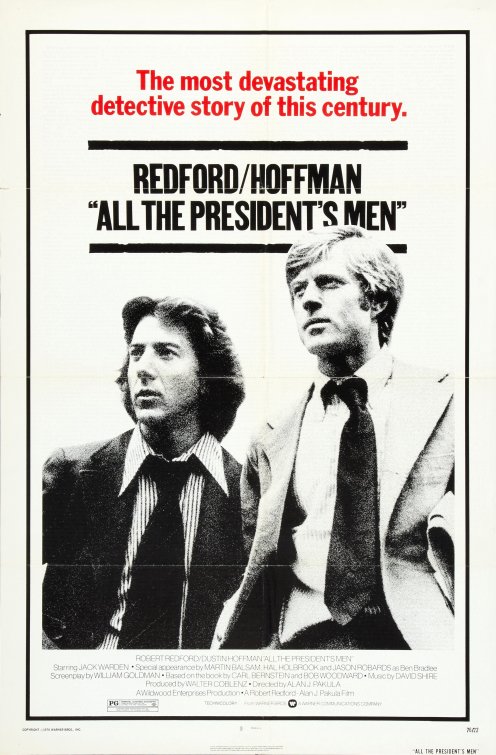
In the case of President's Men, however, sometimes I don't quite get it. Like the break-in - Goldman just says basically to play the scene out however you will, make sure to include this detail or that. It really makes me wonder what were the exact circumstances behind his writing this screenplay. Did he work directly with Pakula or was he just hired by the studio to write the screenplay, separate from any expectations of production? But it must have been clear that this was going to get made - this wouldn't have been a script that could ever have been tossed into a pile and forgotten.
Goldman no doubt went into the writing of this thing knowing that he had to write fast and that this was definitely going to get made.
And of course, when production ramped up, they would start doing their own research. No matter what Goldman put in the script, Pakula's researchers would have found out the exact sequence of the Watergate break-in and known it by heart. And that's probably why he just basically says "Do it, you know what you need to do."
I would say that the way he breaks scenes apart, without scene headings, is probably a mix of the speed at which he was working and the freedom he knew he could employ. He was probably playing around and had his own theories about writing. And now that the deadline was approaching, he put his own ideas about screenplays into effect. Who cares about scene headings? Why does all description need to be perfect and lead you by the hand, beat by beat?
Due to its style, it does have an interesting rhythm and speed to it. Personally, I don't like that the reason behind the style may not be quite as concrete as the other stories. But style is ultimately meaningless. I love the attention to detail, the focus on tracking things down, how every piece of evidence, every name and phone number was important.
It's a brilliant story because it's all about the case and all about the details.

No comments:
Post a Comment